
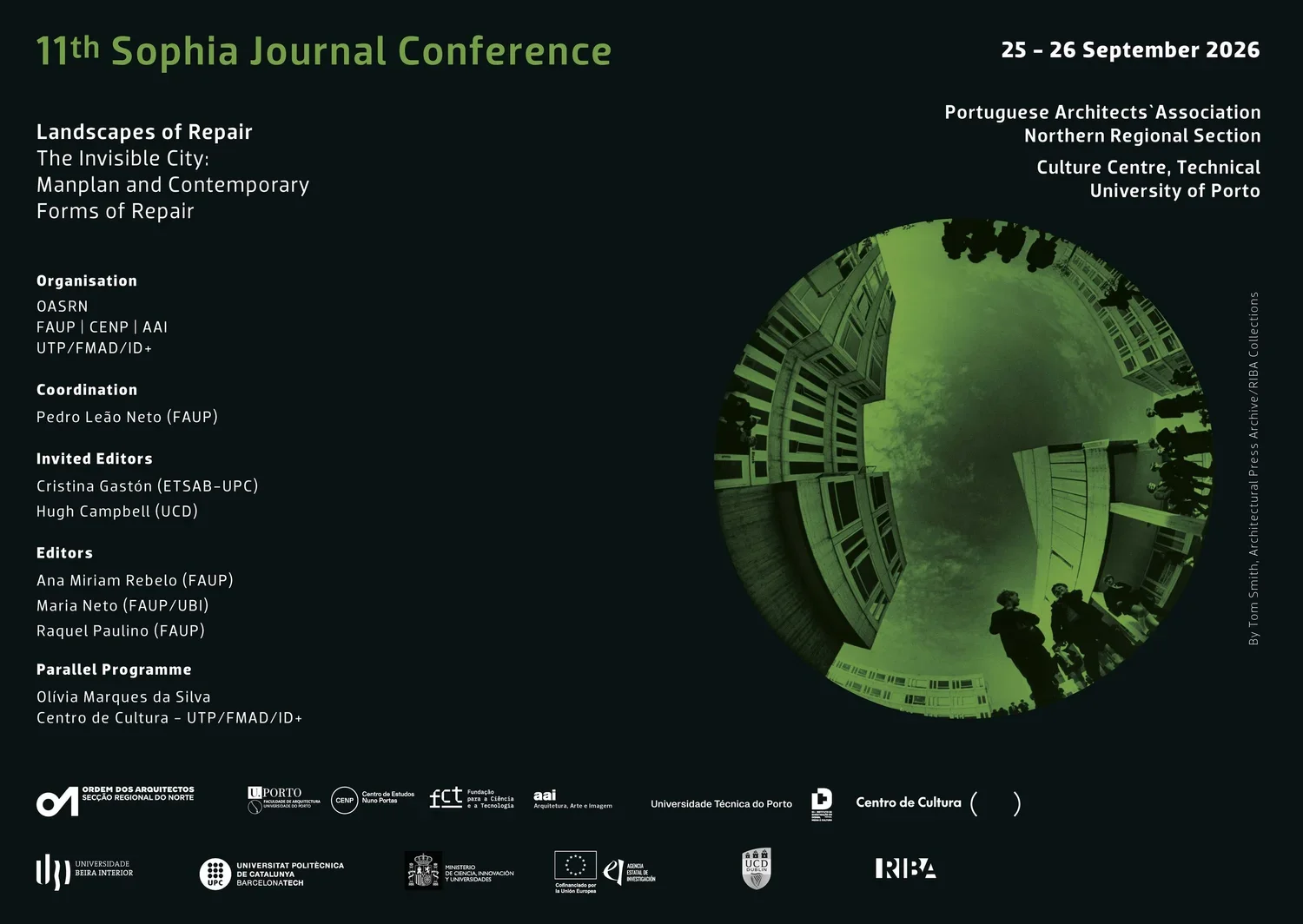
11th SOPHIA JOURNAL INTERNATIONAL CONFERENCE | 25 / 26 September | Portuguese Architects’ Association — Northern Regional Section (OASRN)
EN / PT / SP
Sophia Journal Announces the Programme for the 11th International Conference — Landscapes of Repair
The Invisible City: Manplan and Contemporary Forms of Repair
Portuguese Architects’ Association — Northern Regional Section (OASRN) | 25–26 September 2026
CONFERENCE LIVE STREAMING YOUTUBE . FAUP
https://www.youtube.com/live/Zvsnrhaf4cg?si=fjc65NuZ1nU72eN7
Host Institution
Portuguese Architects’ Association — Northern Regional Section (OASRN)
Program and Book of abstracts
The 11th Sophia Journal International Conference will present a live program organised by Portuguese Architects’ Association — Northern Regional Section (OASRN), Faculty of Architecture, University of Porto (FAUP) | CENP — Nuno Portas Centre for Architectural Studies and Culture Centre, Technical University of Porto — UTP / FMAD / ID+, continuing the successful annual cycle of international forums dedicated to the critical exploration of the intersections between image and architecture.
Sophia Journal international conferences and are closely aligned with Sophia's peer-reviewed publication.
The 11th Sophia Journal International Conference — Landscapes of Repair: The Invisible City: Manplan and Contemporary Forms of Repair will take place in Porto on 25 and 26 September 2026, with an in-person programme and online streaming.
On 25 September, the scientific programme will be held at the Portuguese Architects’ Association — Northern Regional Section (OASRN). On 26 September, the parallel programme will take place at the Culture Centre, Technical University of Porto — UTP, followed in the afternoon by a visit to Quinta da Conceição, in Matosinhos.
Across the two days, the conference will bring together researchers, architects, photographers, artists, editors and other professionals to explore the relationships between architecture, image, the city and contemporary forms of repair.
Part of the fourth thematic cycle of Sophia Journal, the conference proposes a broad understanding of repair. Rather than being understood solely as a technical intervention on buildings, infrastructures or landscapes, repair is approached as an ethical, social, cultural, ecological and imaginative practice, capable of recognising vulnerabilities, bringing often overlooked conditions into view, and renewing relationships between people, places and institutions.
The conference takes as its starting point the critical legacy of Manplan, the series published by The Architectural Review between 1969 and 1970. By confronting the promises of architecture and planning with the realities of everyday life, Manplan shifted the focus of architectural representation away from the isolated building and towards human experience and the social, political and economic systems that shape the conditions of inhabitation.
More than fifty years later, this perspective remains particularly relevant in the face of urban inequalities, housing precarity, deteriorating infrastructures, environmental pressures, the invisibility of maintenance work and other, sometimes less apparent, forms of collective wear and exhaustion.
Making the Invisible City Visible
The Invisible City does not refer here to an absent territory, but rather to a set of experiences, relationships, practices and tensions that tend to remain outside dominant regimes of visibility: ordinary uses of space, informal forms of adaptation, threatened memories, urban voids and interstices, material traces and networks of care that sustain collective life.
Making these realities visible also requires us to reflect on the forms of representation themselves: who produces the images, who is represented, through which languages and framings, and with what consequences.
It is in this sense that photography, film, critical cartography and the visual essay are understood by Sophia Journal not simply as means of documentation, but as instruments of research and knowledge production. They can reveal inequalities and transformations, follow processes of deterioration or abandonment, bring different temporalities into relation and, at the same time, contribute to imagining other forms of care, repair and transformation.
The conference brings together research papers and visual essays that explore these questions through case studies situated in different cities, landscapes, buildings and communities.
From the Legacy of Manplan to Contemporary Practices of Repair
The 11th International Conference continues the programme Wide-Angle View: Architecture as Social Space in the Manplan Series 1969–70, developed at OASRN throughout 2026.
The Wide-Angle View exhibition, which opened on 27 February, revisited the influential photographic series Manplan and was accompanied, between March and May, by a programme of guided visits, public conversations, educational activities and round tables that sought to bring the critical memory of this editorial experiment into dialogue with contemporary questions surrounding housing, the city, public space and representation.
The conference does not bring this process to a close. On the contrary, it extends it, bringing the legacy of Manplan into dialogue with contemporary practices of visual research, representation and intervention, while asking how looking, documenting and making visible may themselves constitute a first form of repair.
For further information:
Programme
Email:
info.sophiajournal@arq.up.pt
